
My Orcs Are Going to Be Whatever I Want Them to Be, Thank You Very Much.
A fresh take on an old argument? Probably not.

There was recently a thread on the Arcane Library (publisher of Shadowdark) Discord server, where the OP asked about how other GMs handle orcs in their campaign. The discussion was very respectful, interesting, and often insightful. In fact, there really was only one one troll-like comment.

So now I’m going to try to answer the question in a more respectful manner.
Why the Controversy?
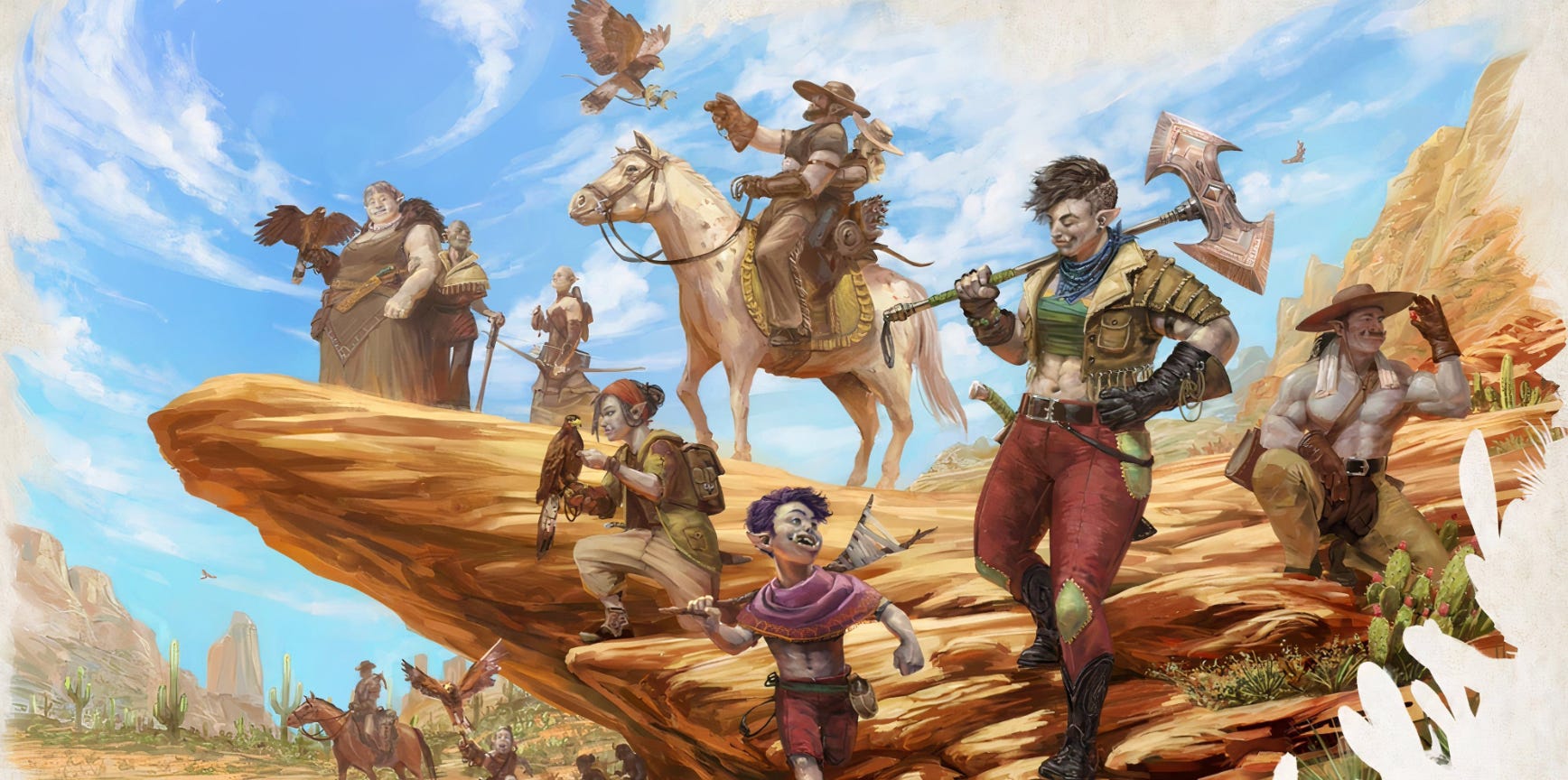
If, unlike me, you are not tied into the content creator hype machine surrounding ttrpgs you might not know that the 2024 update of D&D 5e caused a mini firestorm by removing Orcs from the Monster Manual. Making matters “worse”, the 2024 D&D Players Handbook included a picture of desert orcs some labeled “Mexican coded”.
Many felt they had insight into some nefarious social agenda, but D&D is owned by Hasbro and Hasbro is a publicly traded corporation. There is one thing I can guarantee you, every decision made by any corporation will only ever be designed to maximize shareholder value. Great for your 401k, terrible for everything else but that’s another topic for another writer in another column.
The actions of Hasbro had very little impact on me. I GM one D&D 5e campaign that is more than halfway through its run. We’re not changing anything now – not rules or campaign lore. And even if I did, I would not feel compelled to run any creature the way they are presented in the books if that doesn’t fit my campaign. And I’ve run things that way for over 40 years. So I don’t feel *that* bad for the people who don’t like the changes.
Getting Back to the Original Question
My primary campaign right now – Schadengard – uses Shadowdark as its system, and there’s very little I have to change. Mostly because Shadowdark has a lot less implied setting compared to D&D 5e. Still, the way I run orcs has much more in common with D&D 5e than it does the more “traditional” way and I thought I’d go into why that is.
Disclaimer – this is me, as a GM, expressing *my* opinion about *my* game. If you’re not playing in my campaign then go to town the way you want! And if I come to play your game I’ll either embrace your way of running orcs, or I’ll move on. No temper tantrums here. Save that for TikTok.
Been There, Done That
I might feel a little differently about orcs if it wasn’t for the inclusion of half-orcs as a playable race.
I started playing D&D in 1979, and was a full-time GM in 1980. Of course my initial games were ‘by the book’. It was only later on that some of the tropes of fantasy adventure gaming started to grate on me. One of those tropes was the “noble savage” half-orc. I played a half-orc cleric in another campaign (yes, despite the AD&D level limits) and the story of “he’s not welcome in our town” until he’d do something heroic that benefitted the town folk getting them to accept at least this one noble savage … well it was interesting the first couple of times. Maybe. I get tired of reruns. I like things that knock tropes on their ass. Like AD&D half-orc clerics.
Mommy? Daddy? Where do Half-Orcs Come From?
Also, half-orcs are typically portrayed as being a cross-breed of a human and an orc. If all orcs are evil, then they are not going to be welcome in almost any human area. And while you could certainly could craft a tale where a human willingly consented to joining orc society, or that there exists somewhere a human land so evil that they are willing to let orcs work and live and have children amongst them … but the much more likely explanation is going to be that half-orcs are the result of sexual assault.
A talented author could certainly write a tender and compelling drama that includes SA as a motivating factor for a character, but it’s most definitely not something I’m interested in exploring in my tabletop games.
A Quick but Relevant Detour that’s Not About Orcs
I was running an AD&D 1e game in the early nineties (I was a late adopter of 2e, see the argument above about not changing mid-campaign) and ran a very memorable session where the party went to take on a dragon, only to arrive and find another party beat them to it and were looting the treasure. This party happened to be “evil”, which the party learned via the Know Alignment spell so they started to fight the NPCs instead. Of course that’s when the *real* dragon showed up (the one the others killed was its less powerful mate) leading to a really cool and interesting 3-way battle.
Later, the characters were horrified to see some of those NPCs back in their home city just wandering around shopping and drinking and carousing or whatever. The PCs were friends with the city’s mayor and went to him crying that there were evil people in the city and that they needed to be arrested or at least run out of town!
The mayor: “Well, what crimes did they commit?”
The party: “…”
I think of this as relevant, because I think of it as the moment my campaigns stopped being about easy moral choices. This is also why I hate alignment as a mechanic, but that’s another column.
Easy Answers are Boring
Seriously, if I wanted a game with interesting and creative combat that doesn’t include moral and ethical dilemmas … well there are literally hundreds of boardgames that do that already. If I’m playing (or running) an RPG I want something more than just combat tactics.
In fact, I tend to prefer games where combat is only one option of many... and often not the best option. If my players see some orcs and know that those orcs can be killed just because they’re orcs and orcs are automatically evil then there’s no incentive to bargain, negotiate, or often even avoid an encounter. That’s not why I’m playing an RPG. I’ll go play Conquest of Nerath, or War of the Ring or something instead.
Willing Suspension of Disbelief
“Oh, you expect things to be realistic in a game about wizards and fireballs?” Yes, actually. Or more accurately, we each have our own threshold where suspension of disbelief becomes impossible. There’s a frequent poster in the Arcane Library Discord server who talks about how – as an active backpacker – the idea of marching 20 miles a day on full pack knocks him out of his willing suspension of disbelief. That’s valid!
To me, even two miles would seem heroic so it doesn’t affect me the same. On the other hand, my biggest bugaboo is lava that just does fire damage and doesn’t vaporize you instantly, but whatever.
Another is intelligent creatures that can’t direct their own destiny because of their genes.
Let me nip this in the bud before anybody comes back with “aha! But Shadowdark has bioessentialism! Dwarves are hardy and get more HP! Elves are better at archery and magic! Halflings can turn invisible because reasons!”
Yes, but there’s a big difference between genetic predispositions and a lack of free will.
Enough jibber-jabber! You said you were going to tell us about the orcs in your campaign!
Fair enough. Here are some thoughts behind my decisions.
No Cross-Breeding
If my game is going to have half-orcs (and I was not incentivized to remove them from the Shadowdark core rules) then they are at least not going to be the result of a union between an orc and a human (or other race). Not unless orcs are going to be fully accepted members of society – and even then I’m not interested in exploring the reasons why a human and an orc can have a baby, but not an elf and a dwarf.
In my lore half-orcs are an ancestry completely removed from orcs and humans. Legend says they originally got that name because their brutish looks reminded people of orcs. Others say that both orcs and half-orcs evolved from an ancient common ancestor. The real story doesn’t matter. As long as we can rule out problematic relationship. If someone wants to play a character who was the offspring of SA, (and I think they can handle the story without making it uncomfortable), then let it be between humans.
Emergent story play has made my orcs sympathetic
So far Orcs have figured prominently in three adventures in Schadengard.
1. The first was a tribe of orcs rumored to be interested in an ancient lost artifact that one of my players already sought. Sure enough, when the orcs and the party met up it eventually led to a fight. I had included one special orc amongst the group – a Ras Godai. In truth, one of my players had been running the first Ras-Godai of our campaign (coincidentally a half-orc), and I wanted an excuse to let him take a magical razor-chain off an opponent - but instead he reacted in a way I didn’t expect.
When the orcs were routed and began to flee, my Ras-Godai player had a shot at intercepting and likely delivering the killing blow to the orc Ras-Godai. But he didn’t. He let him go. He was much more interested in learning how this orc came to have eaten of the Black Lotus than he was a +1 razor chain. He then set about researching this particular orc and trying to learn his story.
None of that happens if orcs are “just evil”.
2. I included the adventure Blood & Steel from the excellent Letters from the Dark vol. VII Monster Mash by Chris Powell (that’s redundant … all his zines are excellent). In that adventure, orcs once ran an ancient forge and created a unique material known as Blood Steel. The formula is lost, and the tribe has long since died out – or so it would appear. In actuality, some evilly inclined Duergar have found the forge and have enslaved the remnants of the once-proud tribe and have been experimenting unsuccessfully to reproduce Blood Steel.
I had already seeded this adventure into my rumors anyway, but it was a good continuation of the mysterious orc Ras-Godai’s story. I made him a distant descendant of that tribe, and that he sought personal power to free his distant people from tyranny. He ended up teaming up with some of my PCs (including the aforementioned half-orc Ras Godai) to rout the Duergar and free the slaves. But like many things, it’s not that simple. The tribe has been enslaved for generations, and a return to pride and strength will be a difficult journey. The Ras-Godai now lives amongst them, and my half-orc PC has pledged to return frequently to help guide their progress.
So by now, players in my campaign are already more inclined to see orcs in a sympathetic light.
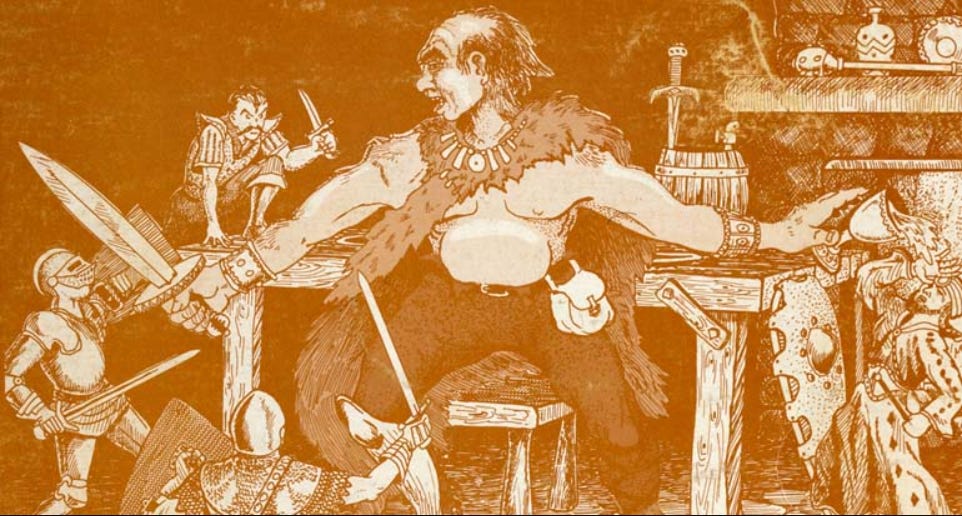
3. And a more recent (and ongoing) development … in a completely different part of the world I’d introduced some trouble-making Hill Giants to give higher leveled characters something to do. This eventually led to the inclusion of the adventure The Steading Crashers – which is a modernized Shadowdark version of G1 Steading of the Hill Giant Chief from TSR in 1977, adapted by gastropo0d. And one major subplot – the Hill Giants have orc slaves, and some of those slaves have escaped to the dungeons below and are fomenting rebellion.
These PCs were initially after the dwarves who were kidnapped by the giants and forced to work the forges, but quickly found the orc slaves as sympathetic, and as potential allies in a fight that would likely be over even their higher-leveled heads. And although the Steading group is completely separate from the Blood & Steel group (Schadengard is an open-table, West Marches campaign), word gets around and the Steading Crashers already heard about the orcs of Bealdmunt (Blood & Steel’s Bald Mountain in my campaign) and see the orcs under the steading as heroic creatures.
My Orcs are Mexican
So getting back to my troll-ish comment. Yes, it’s true. While there are many orcs that don’t fit that mold, I’ve decided that the great tribes of old (including the Bloodsteel Orcs) have a Mexican flavor.
Before any of this ever even happened, before the 2024 D&D 5e PHB was released, back when I was first building Schadengard I had decided that the nearest desert to the home city was not going to be Egyptian or Arabian in flavor, that it would be be based on the North American West – with cacti and rattlesnakes, buffalo, fire ants, mysterious plants that inspire shamanistic spirit quests. And the first time I heard some ‘edge-lord’ make a snarky jab about orcs running taco carts I knew that was a great place for a once proud line of orc tribes.
I have a great fondness for Mexican culture. I’ve never been, but my son married a woman from Sonora, so I have a Mexican daughter-in-law whom I love very much. And that makes my even-more-beloved granddaughter half-Mexican, so you’ll understand why I dislike the culture being treated as the butt of a joke.

Great article. I also very much dislike the alignment system but I think it’s the “good” “evil” axis being added that specifically ruins it.
Law vs Chaos, like the Elric novels that inspired alignment to begin with, makes a lot more sense and is more useful to categorize things.
The orcs in my campaigns are always bloodthirsty raiders, at a society level. But so are most human societies lol! It’s a cultural, belief system based difference, not genetic/racial rules. There’s no moralistic difference between orcs raiding a human town and taking their gold vs humans raiding an orc lair and stealing their gold.
If my players want to believe orcs are evil then I won’t stop them, but it’s not something I proscribed, nor is it something baked into the literal metaphysics of the world
Alignment always feels like a soft workout to express complex ideas in RPGs that never only serves to push the narrative of "we're good, they're evil, so now we have an excuse for guilt-free murder."